Being hurt in a rideshare accident puts you in an unusual position. You did not cause the crash. You were not behind the wheel. That gives you a stronger starting point than most accident victims.
Still, a strong starting position does not mean a smooth claim.
Rideshare cases routinely involve multiple insurance policies, competing adjusters, and disputes between drivers over who caused the collision. Your injuries may be clear, but the claim can bog down when insurance companies argue over responsibility or when gaps in your medical records give insurers room to push back.
Our traffic accident lawyers serve Henderson, Las Vegas, and Summerlin accident victims and have seen what helps and hurts these rideshare claims. In this article, we’ll walk you through the information you need to protect your health and your finances.

Why Passengers Have a Head Start
As a rideshare passenger, you are rarely the focus of a fault investigation. You were not speeding, changing lanes, or running a light. You hired a ride through an app and trusted someone else to drive safely. That shifts the liability conversation toward the drivers involved and away from you.
That matters. When fault does not center on you, the claim can build on a cleaner foundation. Investigators focus on the crash itself, the drivers’ actions, and the insurance coverage tied to the ride. You have one fewer battle to fight than the people behind the wheel.
Even so, a favorable liability position does not protect you from every obstacle. Insurance companies still review every detail of your case. They look at which policy applies, what caused the crash, how serious your injuries are, and whether your medical records support what you are claiming. Starting strong is an advantage, not a guarantee.
Insurance Coverage Is Not Straightforward
One of the biggest sources of confusion in a rideshare passenger claim is the layered insurance structure that rideshare companies use.
Uber and Lyft apply different coverage tiers, depending on what the driver was doing when the crash happened. Coverage can shift based on whether the driver had the app turned off, whether they were waiting for a ride request, whether they were on their way to pick someone up, or whether a passenger was already in the car. Each situation triggers different policies with different limits.
As a passenger, you may expect the rideshare company’s insurance to handle everything. In practice, multiple policies can come into play at once, and the insurers behind them may each argue that someone else’s policy should respond first. That process takes time, and your medical needs do not pause while the companies sort out who pays.
When Drivers Dispute Fault
Picture this: You are riding in a Lyft when another car runs a red light and hits the vehicle. You assume the other driver caused the collision. The other driver’s insurer points at the Lyft driver and claims an unsafe turn. The Lyft driver’s insurer pushes back just as hard. Meanwhile, you are managing doctor visits, missing work, and dealing with pain that affects everything from your sleep to your ability to do basic daily tasks.
Each insurer has a financial reason to minimize its share of responsibility. The back-and-forth between them can drag on longer than most passengers expect, and it delays compensation while you are still dealing with the real-world consequences of the crash.
Your Medical Records Carry Real Weight
Medical documentation is central to any accident claim, and rideshare passenger claims are no exception.
Insurance companies do not just want to know that you were hurt. They look at when you sought treatment, how consistently you followed up, what symptoms you reported at each appointment, and whether your records show a clear connection between the crash and your injuries. A record that tells a consistent story works in your favor. One with gaps or inconsistencies gives insurers room to challenge what you are claiming.
This matters most for injuries that do not show up immediately. Soft tissue damage, back pain, and concussions often get worse in the days after a crash once the adrenaline fades. You may feel fine right after the accident and choose not to see a doctor. You may even give insurers a recorded statement claiming you feel fine, only to have the pain come on with a vengeance a couple of days later. This gives insurers a window to discredit your claims.
You can protect yourself by seeking medical help early and following through with all recommended treatments.
Why Gaps in Treatment Hurt Your Case
Insurers pay close attention to gaps in your treatment timeline, and they do not give the benefit of the doubt when they find them.
If you go to urgent care once and then wait several weeks before following up, the adjuster will ask what happened in between. If you stop treatment early because the pain seemed manageable, the insurer may argue that your injuries resolved quickly and did not require ongoing care. If you missed appointments and did not reschedule them, your records may make your condition look less serious than it actually was.
People skip follow-up care for understandable reasons. Life gets busy. Medical bills add up. The pain comes and goes, and some days feel more manageable than others. Those choices are human, but they can quietly damage your claim. Consistent treatment builds a record that reflects how the injury actually affected your life over time.
Multiple Insurers May Contact You Directly
Rideshare claims often come with more insurance communication than people expect, and those conversations can have a big effect on your claim.
You may hear from the rideshare driver’s insurer, the other driver’s insurer, and sometimes additional carriers tied to the claim. Each may ask for a recorded statement, a medical authorization, or your account of how the accident happened. It is generally wise to avoid giving a recorded statement before you have a clear picture of your injuries and how they are progressing. What feels like a routine check-in can become part of the insurer’s record for the case.
A casual comment like “I am doing better” can be used to argue that your injuries resolved early. A rough description of how the crash happened may later conflict with a police report or another party’s statement.
How to Protect Your Case
You cannot control how insurers handle coverage disputes, but you can control the strength of your own case.
Follow these steps:
- Document the crash. Screenshot your rideshare trip receipt and take photos of the accident scene if you are feeling well enough to do so. Photograph your injuries if they are visible, and keep a record of any communications from the rideshare companies.
- Seek immediate medical care. Even if your symptoms seem minor, it’s a good idea to seek medical care. Your doctor may be able to catch developing problems before they get worse, and they can start a record tying your medical care to your accident.
- Be consistent with treatment. Don’t skip appointments. Take medications as prescribed. Show up for all recommended therapies. Insurers look for gaps in care and try to exploit them. Don’t give them that opportunity.
- Keep medical records and receipts. Keep a copy of your records, prescriptions, referrals, and out-of-pocket costs connected to your care.
- Don’t “overshare” with insurers. When speaking with adjusters, don’t downplay your symptoms, guess about recovery timelines, or offer an offhand assessment of how you are feeling. Consider having an attorney speak to the insurers on your behalf, as they can provide the needed information without disclosing anything that could compromise your case.
- Keep a medical journal. Write down how your symptoms change from day to day and how they affect your work, sleep, and daily routine. Did your symptoms require you to miss a week of work? Or are they causing you to wake up at night every few hours? Writing those details down while they are fresh creates a personal record that can add real context to your case.
- Consult with an attorney. A skilled car accident injury attorney can defend your case with strong evidence and make sure your rights don’t get lost or minimized in the battle between different insurers. This may include negotiating with insurers to make sure they offer you an acceptable settlement. If insurers won’t cooperate, an attorney can represent you in court.
Act Now to Protect Your Claim
Liability disputes and insurer tactics can all chip away at a claim that looked straightforward from the start. But when you take the right steps from the get-go, you can create a record that is hard to dispute and maximize your chances for the recovery you deserve.
Video

Infographic
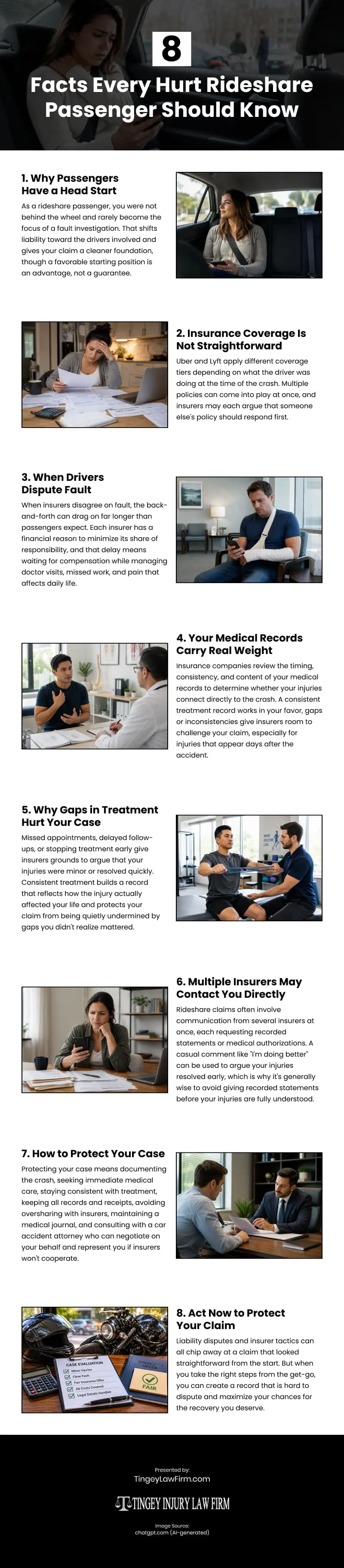
Being injured as a rideshare passenger gives you a stronger starting position than most accident victims, but that advantage only holds if you understand the claims process and take the right steps early. Find out key facts every hurt rideshare passenger should know in this infographic.