



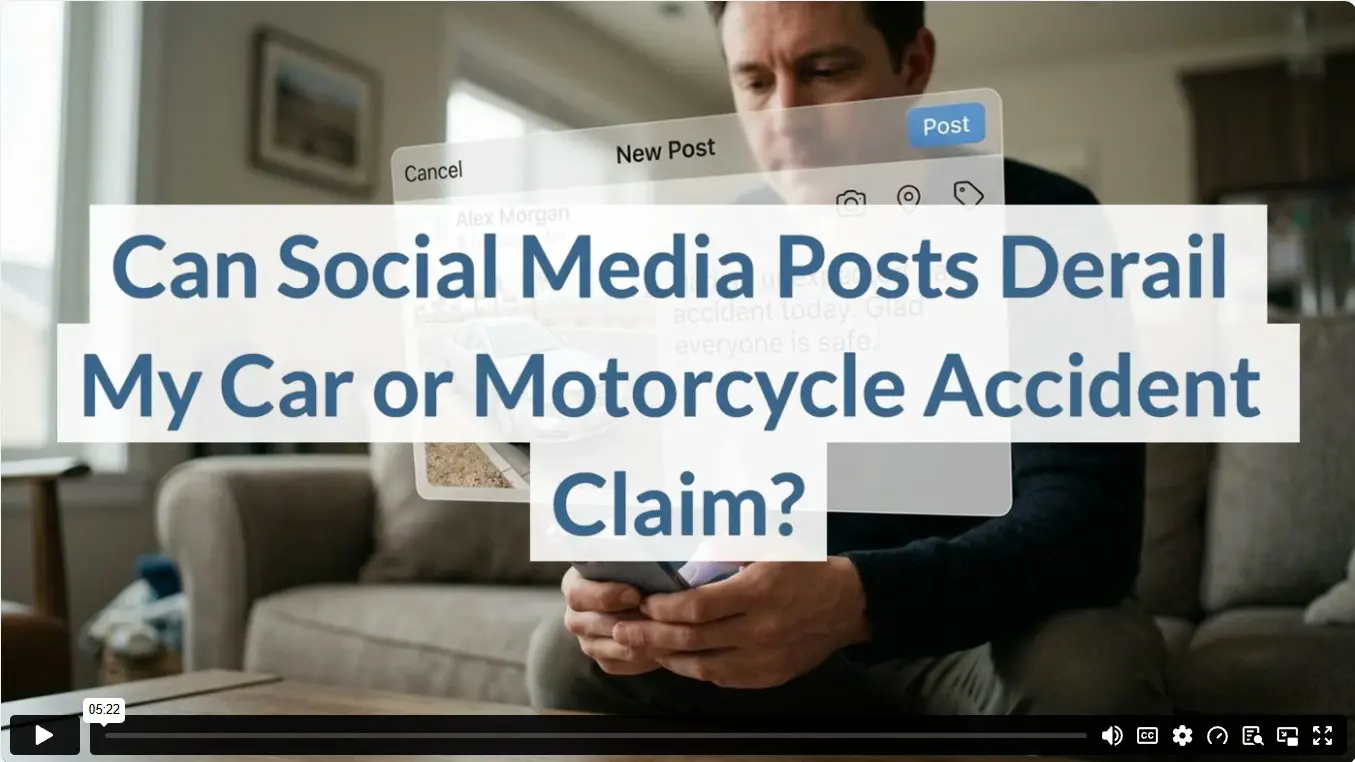
After your car crash, you’re dealing with injuries, insurance calls, and the pressure of an open claim. The last thing you expected was to find out someone posted about the crash on social media. Maybe it was a bystander who filmed from the sidewalk, a witness trying to share what they saw, or a friend who meant well. Regardless of who posted it or why, the moment it went live, it gained power to affect your case.
Social media posts related to your accident don’t stay in a vacuum. Our car accident injury attorneys here in Las Vegas frequently see these posts enter the public space and create harmful legal exposure.

Why Social Media Posts Matter in an Injury Claim
Insurance companies routinely monitor social media as part of the claims process. Adjusters look for any publicly available information that gives them leverage to reduce or dispute a payout. A post that looks like a casual account of the accident to you reads as potential evidence to them.
This extends well beyond your own accounts. A post from a witness or bystander can surface in an investigation. Screenshots from third-party posts have been used in car or motorcycle claims to challenge the driver’s account of the crash, dispute the severity of injuries, or raise new questions about fault. The fact that someone else created the post doesn’t limit how it can be used against you.
There is also the permanence issue. Let’s say that you are able to get a post about the accident taken down. You feel a wave of relief, but then learn that the other party took a screenshot of the post before it was deleted. Courts and insurance companies will likely be able to use that screenshot as evidence. And insurance companies don’t just rely on screenshots. They may be able to subpoena platforms or use digital forensics to recover content.
Some people make the mistake of thinking that an old post is a dead post, but insurance companies can work on slow timelines. They may wait weeks or months, then comb through past social media posts. A post you thought was old news can resurface as a central piece of their argument against your claim.
How a Post Can Damage Your Claim
A post with photos or video from the scene carries a lot of risk. Adjusters and defense attorneys can analyze the position of your car or motorcycle, the road conditions in the frame, your apparent physical condition immediately after the crash, and the state of the other vehicle. That imagery can be used to argue that the scene looked different from what you’ve described.
A post where someone comments on what happened, including a well-meaning explanation from a friend or witness, can conflict with your official account. Even minor discrepancies in how the crash is described can create inconsistencies that get used against you during the investigation or in court.
Timeline details create their own problems. A post that includes the time it was published, combined with location data or other identifiable details, can place you, the other driver, or the accident itself in a different context than your claim describes.
Even posts that don’t directly reference the accident can be hurtful. For example, maybe a friend tags you at a local 5K race. You know you walked the race at a slow pace, in spite of your concussion from the crash, but your friend’s post gives the impression that you were running your best race. The insurance seizes on the post to cast doubt on the severity of your injuries.
The common thread is inconsistency. Insurance adjusters are looking for any gap between what you’ve described and what the public record shows.
What to Do When Someone Posts About Your Accident
The first step is documentation. Before anything else, take a screenshot of the post with the timestamp visible. Save it somewhere you can access it easily. The post may seem minor right now, but your attorney will want a record of what was said, who said it, and when.
After documenting it, resist any impulse to respond. Commenting on the post, correcting the record in the comment thread, or sharing it with a rebuttal creates more visible content connected to your case. A calm, factual correction can still be taken out of context or used to establish what you knew and when. And it’s not just public engagement that you should avoid. Even direct messages can be framed as harassment, tampering with evidence, or intimidating witnesses.
The best course of action is to talk to an attorney. When a post includes misinformation about fault, the sequence of events, or the nature of your injuries, your attorney can assess whether it needs a formal response or should be preserved as evidence. The earlier your attorney knows, the more options are available. Waiting gives the other side time to use the post before you’ve had a chance to address it.
Protecting Your Own Social Media During a Claim
While someone else’s post may have started this, your own social media activity carries just as much risk during an open accident claim. Anything you post, or are tagged in, can be reviewed by the other side.
Avoid posting anything connected to the accident, your injuries, or your recovery. Stay off platforms where friends might tag you in locations or activities. A photo of you out at dinner or at an event can be used to suggest your injuries aren’t as limiting as you’ve claimed, even when the photo captures one manageable day in the middle of weeks of real pain and limited mobility.
A lot of people think they are managing their risk by tightening up their privacy settings. However, mutual contacts can still see and share their posts, and a determined investigator can sometimes access content through indirect means. The most reliable approach is to:
- Set all accounts to private.
- Pause posting on all platforms.
- Let close friends and family know you have a pending accident claim and ask them not to post about you or the claim.
- Turn on manual approval for tags to limit what people can post about you.
- Avoid new friend requests, as they could be coming from the opposing legal team masquerading as “friends.”
- Don’t remove content, as it could be viewed as tampering with evidence.
A Las Vegas Accident Attorney Can Protect Your Claim
Motor vehicle claims are already complicated enough. Adding a social media element creates variables that are hard to manage without legal guidance.
An attorney can review any posts connected to your accident. They can advise you on the risks they pose and the best course of action to minimize those risks.
You don’t have to navigate this alone. Contact our accident attorneys serving North Las Vegas, Vegas, Summerlin, and Henderson.
Video
Infographic
