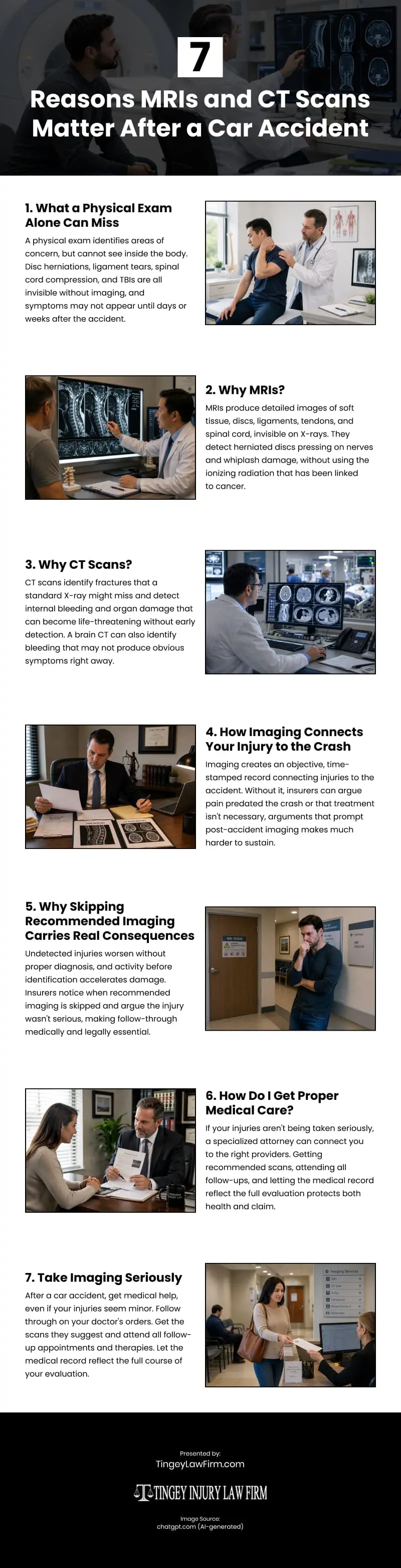
Right after a car accident, adrenaline does a lot of heavy lifting. It gives you the power to face present danger, but it also masks pain. That can be good in the moment, but it can keep you from fully understanding all your body has gone through.
Because of adrenaline, some injuries may not announce themselves right away. You may walk away from the accident feeling fine, not realizing that you’ve sustained soft tissue damage, disc injuries, internal damage, or a traumatic brain injury (TBI).
That’s where MRIs and CT scans come in. They can reveal “hidden” injuries and change how you approach both your recovery and your claim.
What a Physical Exam Alone Can Miss
A thorough physical examination after a car accident reveals a great deal about your condition and is an important first step. It also has limits.
A doctor assessing your range of motion, pressure response, and neurological reflexes can identify areas of concern and note signs of injury. What a physical exam cannot do is see inside your body. You may have disc herniations, ligament tears, spinal cord compression, TBIs, and internal injuries that your doctor can’t see or measure.
In the days or weeks that follow, you might experience worsening neck stiffness, pain that shoots down the arm or leg, persistent headaches, and numbness in the hands or feet. These symptoms can all point toward damage that can only be confirmed through imaging. Without imaging, your diagnosis will remain incomplete, and your treatment will be built around an unfinished picture.
Imaging provides the detail that transforms a symptom into a diagnosis and a diagnosis into a treatment plan. That sequence matters for your health and your legal claim.
Why MRIs?
Magnetic resonance imaging, or MRI, is particularly well-suited for evaluating soft tissue injuries, which are among the most common outcomes of car accidents and are routinely invisible on standard X-rays.
An MRI produces detailed images of the intervertebral discs, the cushions between the vertebrae that make up your spine. A herniated or bulging disc can press on nearby nerves, causing pain, numbness, or weakness in parts of the body that may seem disconnected from the original injury site. An MRI may be able to detect neck injuries that affect nerves running into the arms and lumbar injuries that affect the legs. This imaging can reveal what a surface-level examination would not catch.
MRIs are also used to evaluate ligament and tendon damage, injuries to the spinal cord itself, and soft tissue damage to muscles and joints that have been subjected to the rapid, forceful movement a crash produces. For example, an MRI may be able to detect the damage caused by whiplash. Whiplash involves the sudden acceleration and deceleration of the neck that strains or tears structures not visible through any other method commonly used in post-accident evaluations.
MRIs do not use the harmful ionizing radiation that has been linked to cancer. This makes them safe for repeated evaluation when tracking recovery. They take longer to complete than CT scans and are more sensitive to movement, but for assessing soft tissue damage in the neck, back, and extremities after a car accident, they often produce the most detailed picture available.
Why CT Scans?
CT scans and MRIs are both valuable tools, but they answer different questions. A computed tomography scan, or CT scan, uses X-ray technology to create cross-sectional images of the body and is often the faster option in urgent evaluations.
CT scans produce detailed images of bone structures, making them useful for identifying fractures that a standard X-ray might not fully capture. After high-impact collisions, fractures in the spine, ribs, and extremities can be present even when pain is partially masked. A CT scan can locate and characterize those fractures in precise ways that guide treatment decisions.
Internal bleeding and organ damage are also evaluated through CT imaging. Blunt force injuries from a car accident can damage organs without producing external signs, and those injuries can become life-threatening if they go undetected. A CT scan in the emergency room helps rule out or confirm that kind of damage before symptoms escalate.
Head injuries are another common application. A CT scan of the brain can identify bleeding or bruising that may not produce obvious symptoms initially but can worsen quickly.
In many accident cases, both CT scans and MRIs are used at different stages. A CT scan may occur in the emergency room to rule out immediately dangerous conditions, while an MRI follows to assess soft tissue and structural damage in greater depth.
How Imaging Connects Your Injury to the Crash
Diagnostic imaging does more than guide treatment. It creates an objective, time-stamped medical record that connects your injury to the accident.
Insurance companies that want to protect their bottom line become very good at finding gaps in medical documentation. An injury supported only by a physical exam and self-reported symptoms is easier to challenge than one backed by imaging that has been reviewed and interpreted by a physician. Without imaging, an insurer can argue that your pain predated your accident, that the accident could not have caused injuries as bad as the ones you’re reporting, or that the treatment you’re pursuing is not medically necessary. Imaging make those arguments harder to sustain.
Imaging is especially important in cases involving disc injuries, spinal damage, and traumatic brain injuries, where the full severity of the condition may take time to emerge. When imaging taken shortly after the accident shows specific damage, it anchors the diagnosis to the event. Imaging taken months later, or not taken at all, leaves a gap that the other side may try to exploit.
Why Skipping Recommended Imaging Carries Real Consequences
Some people hesitate when a doctor recommends an MRI or CT scan. They may worry about the cost and the time involved. They may think that their injuries aren’t bad enough to justify additional testing. Those hesitations are understandable, but they carry consequences.
From a medical standpoint, undetected injuries like internal damage and disc injuries can worsen over time. Returning to physical activity or normal work before an injury has been properly identified and addressed can accelerate your injuries. What might have been a manageable recovery can become a longer and more complicated one when the underlying condition goes undiagnosed.
From a legal standpoint, an insurer reviewing your records will notice that imaging was recommended and not followed through on. The insurer may argue that if the injury had been serious, you would have gotten the scan.
How Do I Get Proper Medical Care?
In some cases, you may feel like your injuries are not being taken seriously. A doctor may tell you that your injuries seem minor or that imaging is not needed. A specialized lawyer can help point you to the right medical providers. For example, a brain injury lawyer here in Las Vegas can connect you to specialists who can use imaging to detect a traumatic brain injury and document your case so your health record supports your legal claim.
Take Imaging Seriously
After a car accident, get medical help, even if your injuries seem minor. Follow through on your doctor’s orders. Get the scans they suggest and attend all follow-up appointments and therapies. Let the medical record reflect the full course of your evaluation. If you are not getting proper care, search for an “accident attorney near me.”
Video
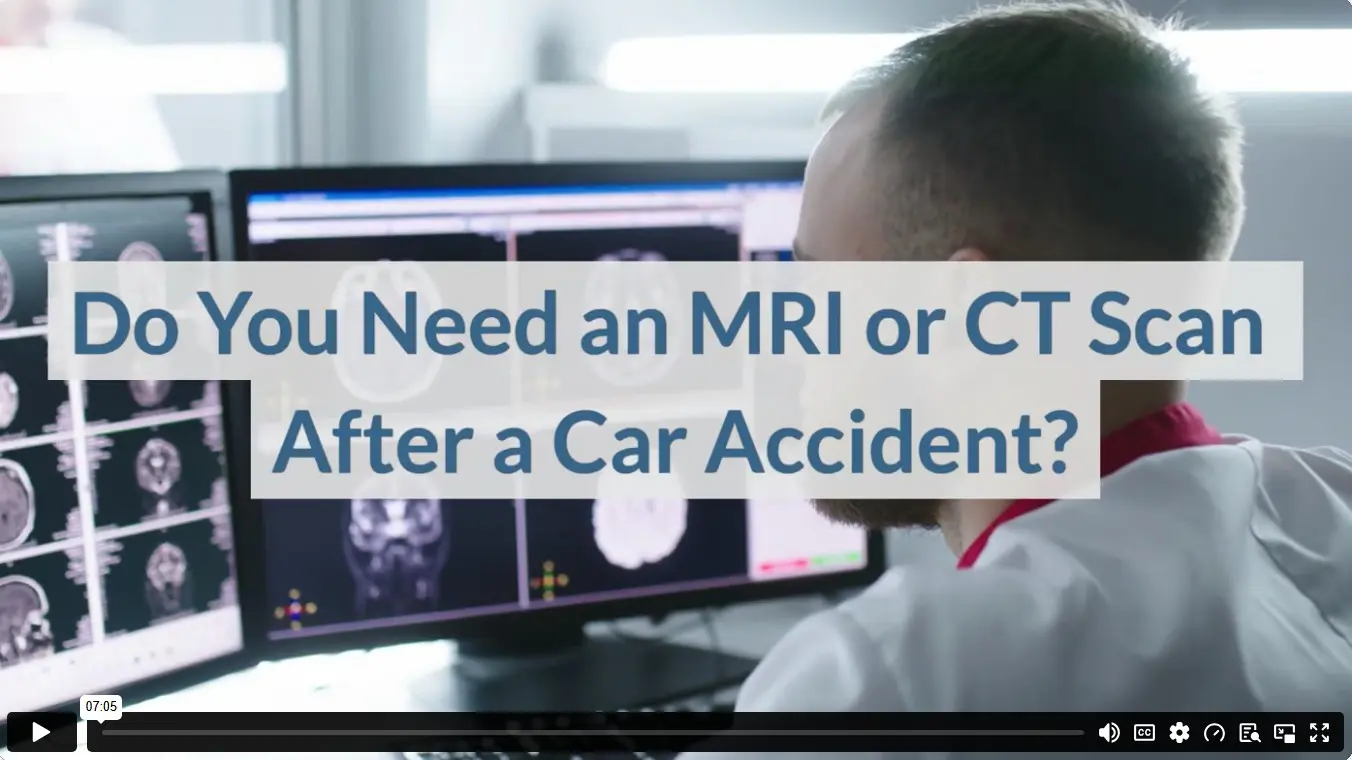
Infographic
Adrenaline after a car accident masks pain, and many serious injuries go completely undetected without imaging, putting both recovery and legal claims at risk from the very start. Discover the reasons MRIs and CT scans matter after a car accident in this infographic.