



A slip and fall might seem minor at first, but these accidents often lead to serious injuries, expensive medical bills, and prolonged recovery times.
If you’re hurt after a slip and fall accident, you may be able to file a claim to cover your financial losses and even pain and suffering. But first, you’ll need to prove that your injury was the result of someone else’s negligence.
Through this blog, our Las Vegas accident attorneys will help you understand exactly what negligence means and how you can prove it to support your claim.
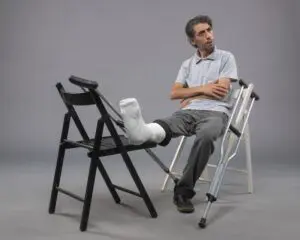
(KamranAydinov/Freepik)
Understanding Negligence in a Slip and Fall Case
Negligence in a slip and fall case hinges on demonstrating that another party (often the property owner) failed to maintain a safe environment for visitors. This responsibility, legally known as a “duty of care,” requires owners to identify and fix hazards promptly. If a property owner neglects this duty and you’re injured as a result, you could have grounds for a negligence claim.
For instance, imagine you’re shopping at a busy supermarket. You slip on juice that had spilled over an hour earlier and was never cleaned up or marked with warning signs. In this scenario, you would need to establish that the supermarket had ample opportunity to notice and address the hazard but failed to do so. You would also need to show that this failure directly contributed to your injuries.
The Elements Required to Prove Negligence
To successfully establish negligence, you must clearly demonstrate these four elements:
- Duty of Care: The property owner had a legal obligation to maintain safe conditions.
- Breach of Duty: The owner failed to uphold this obligation.
- Causation: The breach of duty caused or contributed to your injury.
- Damages: You suffered harm or injury due to the fall.
Now, let’s see how these work together. If you trip and fall because of a damaged step at your apartment complex, you’ll need evidence that the property owner was responsible for maintaining the stairs. You must also show that they knew about the faulty stair (or should have known) and neglected to repair it. Then, you must provide evidence like medical records showing the extent of your injuries and that your injuries were caused by your fall.
Gather Evidence to Strengthen Your Case
Solid evidence boosts your chances of winning a negligence claim. The sooner you collect evidence, the stronger your case becomes. Begin by documenting the scene immediately after your fall or having someone document it for you.
Take clear photos of the hazard that caused your accident—like the damaged step. Get contact information from eyewitnesses who can describe the incident. Their testimonies could prove crucial, especially if the property owner disputes your version of events.
Also, make sure to report the incident immediately to the property manager or business owner. Request a written incident report and keep a copy for your records.
Prompt reporting not only ensures that details get documented while they are still fresh. It also underscores the seriousness of your slip and fall accident.
Establishing Notice: Did the Owner Know?
What if the owner of your apartment complex claims they didn’t know anything about the broken stair? The burden is on you to prove that they did know or should have reasonably known about the dangerous condition. Proving “notice” typically falls into two categories: actual or constructive notice.
Actual notice occurs when the owner directly knows about a hazard. For example, maybe your neighbor reported the broken stair to the owner two weeks before your accident.
Constructive notice refers to conditions that existed long enough that the owner should have discovered them. For example, you may argue that your apartment should have known about and fixed a dangerously broken stair within a week.
Who’s Responsible?
While the property owner is often responsible for a hazard, there could be other negligent parties. For example, let’s say that they hired a third-party maintenance team to fix the step. The team said they repaired the step and billed the owner accordingly but never showed up. Or maybe they did show up but did sloppy work. In that case, your claim may be directed toward the third party.
Proving You Were Not at Fault
Just as you must prove that the property owner was at fault, you must prove that you were not at fault. This can get tricky when insurance companies try to shift blame to victims, claiming they weren’t paying attention or ignored obvious warnings. This is where evidence like photos, security footage, and witness accounts can defend you.
Suppose your property owner tries to say that you injured yourself on the broken step because you ignored signs. Photo documentation can show that there were no signs—-or that the signs were not properly placed to notify you of the broken step.
If you do end up having some fault in the case, that doesn’t mean that you lose all rights to compensation. As long as you’re less than 50% at fault in Nevada, you could still receive compensation (reduced by the percentage you’re deemed responsible for the accident).
Navigating Insurance Company Tactics
Insurance companies are very skilled at challenging negligence claims. They typically scrutinize every detail, looking for ways to minimize or deny your claim. Common tactics include arguing that your injuries are not as bad as you say they are, that your injuries were pre-existing, or that the property owner did all they could to prevent your injury.
This is where your documentation becomes critical. You can’t fight these tactics with emotion or a compelling story. You need evidence: pictures of the accident scene, witness statements, medical records, etc.
Do I Need an Attorney for my Slip and Fall Case?
Although you might think handling your slip and fall claim independently saves money, it’s often counterproductive. An attorney can make sure you file your paperwork promptly to comply with the statute of limitations. They can also help you gather the most compelling evidence and witness statements to support your case (before evidence disappears or eyewitnesses forget their stories).
An attorney will also understand exactly how personal injury laws operate and how to prove negligence. For instance, your lawyer can coordinate with experts to analyze the hazard, providing expert testimonies about industry safety standards that were not met.
An attorney can also negotiate aggressively with insurance companies, protecting you from lowball settlement offers. For example, let’s say you sustained a TBI during your accident and the insurance company is pressuring you to settle quickly. Your injury hasn’t fully healed yet, and you don’t know what the future will bring. A specialized brain injury lawyer will have a good idea of what to hold out for and when to settle (or not settle) so that you have enough to cover future medical bills, missed work days, adaptive equipment, etc.
If necessary, your lawyer can pursue your case in court, using clear, convincing evidence to help you recover lost wages, medical costs, and pain and suffering (non-financial losses tied to the physical and emotional pain you have suffered).
Don’t Suffer Needlessly
You don’t have to bear the brunt of a slip and fall injury on your own. If you were injured due to the negligence of others, the laws protect you. They are designed to give you the financial help you need to recover properly.
Don’t leave your compensation to chance. Reach out to an experienced slip and fall attorney who can guide you step by step, ensuring you receive the justice and compensation you deserve.